How to Get Your AZ License: A Step-by-Step Guide for First-Time Truck Drivers
April 30, 2026
Benefits of Becoming a Truck Driver in Canada
May 27, 2026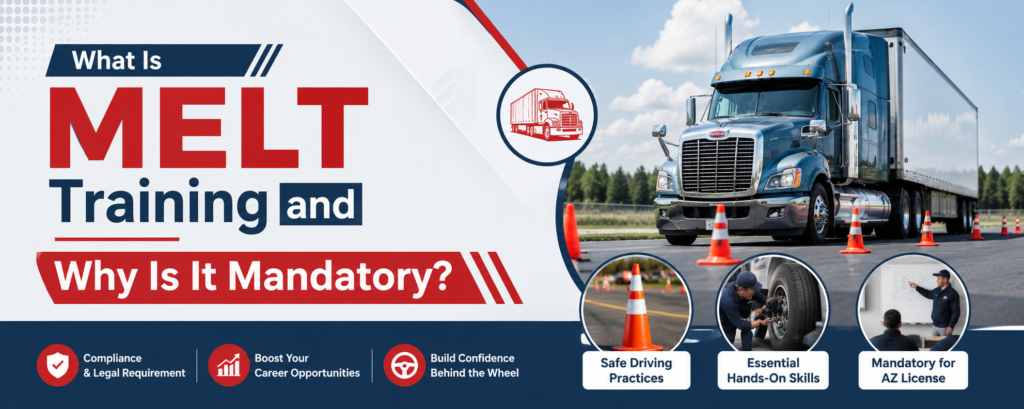
For decades, obtaining a commercial truck driver’s licence in Canada was largely a matter of showing up for a road test. Self-study and informal mentorship were common preparation methods, and the quality of training varied enormously from one candidate to the next. The result was a workforce with inconsistent foundational skills entering one of the most physically demanding and safety-critical occupations on Canadian roads.
That changed with the introduction of Mandatory Entry-Level Training — widely known as MELT. Adopted across Canadian provinces as a standardized prerequisite for obtaining a Class 1 commercial driver’s licence, MELT represents the most significant reform in commercial driver licensing in generations. For anyone considering a career in trucking, understanding what MELT involves, why it was introduced, and what it means for your career path is essential.
What Is MELT Training?
MELT — Mandatory Entry-Level Training — is a structured, government-mandated curriculum that all new applicants for a Class 1 (or equivalent) commercial driver’s licence must complete before they are eligible to take their provincial road test.
The program was developed collaboratively by the Canadian Council of Motor Transport Administrators (CCMTA) and provincial transportation ministries in response to longstanding concerns from the trucking industry, road safety advocates, and law enforcement about the readiness of newly licensed commercial drivers. It sets a national baseline of knowledge and practical skill that every new driver must demonstrate before being permitted to operate a commercial vehicle on public roads.
The MELT curriculum covers two primary domains: theoretical knowledge and practical behind-the-wheel competencies. Both must be completed through a provincially approved training provider — meaning you cannot self-certify or substitute work experience for formal MELT instruction.
What Does MELT Training Cover?
The MELT curriculum is comprehensive by design. It addresses the full operational reality of commercial truck driving, not just the mechanics of steering and braking. Core components include:
Air Brakes and Mechanical Systems. New drivers learn how air brake systems function, how to identify and respond to system faults, and how to conduct proper pre-trip inspections. Understanding air brake behaviour at highway speeds — including brake lag, fade, and rollover thresholds — is critical safety knowledge that the old informal training pathway often failed to adequately address.
Pre-Trip Inspection Procedures. MELT requires that drivers be able to conduct a complete and systematic vehicle inspection before every shift. Trainees learn what to look for in tires, lights, coupling systems, load securement equipment, mirrors, and fluid levels — and how to document findings accurately in a trip inspection report.
Coupling and Uncoupling. Properly connecting and disconnecting a tractor from a semi-trailer is a procedural skill that requires both knowledge and hands-on repetition. MELT ensures all new drivers practice this sequence to standard before licensing.
Backing and Maneuvering. Commercial vehicles behave very differently in reverse than personal vehicles, and the consequences of misjudging clearances in tight spaces are significant. MELT includes dedicated practical training in backing techniques, including straight-line backing, offset backing, and alley dock procedures.
Hours of Service Regulations. Canada’s federal hours of service rules govern how long a commercial driver may operate before mandatory rest periods are required. MELT ensures new drivers understand these rules thoroughly, including how to maintain accurate log records and avoid violations that carry both legal and safety consequences.
Cargo Securement. Improperly secured loads are a leading cause of highway incidents involving commercial vehicles. MELT includes instruction on load distribution, securement techniques, and the federal regulations governing cargo security.
Highway and Urban Driving. Trainees complete supervised driving hours on both urban roads and controlled highway environments, allowing them to develop competency in the conditions they will actually encounter professionally.
Emergency Procedures. Brake failure, tire blowouts, skids, and equipment malfunctions require specific driver responses. MELT introduces new drivers to emergency procedures in a structured way that builds genuine preparedness rather than theoretical familiarity.
How Long Does MELT Training Take?
The minimum MELT training hours are defined provincially but generally require a minimum of 103.5 hours of combined training — roughly 40 or more hours of in-truck driving time and the remainder in classroom or simulation-based instruction. Some training providers deliver the program over six to eight weeks on a full-time schedule; others offer extended part-time formats that stretch the curriculum over several months to accommodate candidates who are working during training.
The road test for a Class 1 licence — which assesses the skills developed during MELT — can only be scheduled after the training provider has certified completion of the full curriculum. Skipping or abbreviating any component is not permitted under the mandatory framework.
Why Was MELT Made Mandatory?
The push for mandatory entry-level training in Canada came from a convergence of safety data, industry pressure, and federal policy momentum. Several key factors drove the policy change:
Road Safety Statistics. Incidents involving large commercial vehicles disproportionately result in serious injuries and fatalities. Analysis of collision data consistently pointed to driver error — and specifically to gaps in foundational knowledge and skill — as a contributing factor. Policymakers recognized that voluntary training had not produced consistent results and that mandatory standards were necessary.
Industry Demand for Minimum Standards. Reputable carriers had long been calling for a baseline training requirement that would ensure every newly licensed driver met a common standard of competence. The absence of mandatory training meant that insurers, dispatchers, and fleet managers had no reliable way to assess the readiness of new hires beyond paper credentials.
Cross-Border Alignment. Canada’s largest trading partner, the United States, already had its own entry-level driver training requirements in place for federal motor carrier licensing. Harmonizing Canadian licensing standards with American frameworks supports easier cross-border commercial trucking operations and labour mobility.
Public Confidence in Road Safety. Large transport trucks share highways, urban streets, and residential zones with cyclists, pedestrians, and personal vehicles. Mandatory training standards are part of a broader commitment by provincial and federal governments to ensure that the operators of these vehicles are genuinely prepared for the responsibility.
Read more : Is MELT Training Mandatory in Ontario for Truck Drivers?
MELT Training Costs and Financial Assistance
The cost of completing MELT through an approved training provider varies by province and institution but typically ranges from $7,000 to $15,000 for the full program. This is a meaningful investment — but it is considerably less than most post-secondary programs, and the return on that investment through a trucking career is substantial.
Several pathways exist to offset or eliminate out-of-pocket training costs. Many carriers offer sponsored training arrangements, covering MELT tuition in exchange for a contractual commitment to drive for the company for a set period following licensing. Provincial employment programs in several jurisdictions provide grants or subsidized training through approved providers, particularly for candidates who meet eligibility criteria related to employment status or sector of interest. Federal skilled trades funding may also apply to commercial driving training in certain provinces.
Prospective drivers are strongly encouraged to research available financial support before paying training costs out of pocket, as the landscape of available assistance is substantial and underutilized.
How to Choose an Approved MELT Training Provider
Not all truck driving schools deliver MELT-approved curriculum. Provincial transportation ministries maintain lists of approved training providers, and selecting a school from that list is mandatory — training completed at a non-approved institution will not count toward licensing requirements.
When evaluating training providers, look beyond approval status to assess the quality of equipment available for practice, the ratio of students to trucks for behind-the-wheel instruction, the experience and credentials of instructors, and the pass rates of graduates on their Class 1 road tests. Schools with high first-attempt pass rates and strong industry connections — including relationships with carriers who offer post-graduation employment — provide meaningfully better value than low-cost alternatives that cut corners on practical instruction.
What Happens After MELT?
Completing MELT and passing your provincial road test earns you a Class 1 commercial driver’s licence — the foundational credential for long-haul and full tractor-trailer operations across Canada. From there, professional development continues through practical experience, with many employers providing mentorship programs that pair new licence holders with experienced drivers during their first months on the road.
Additional endorsements — dangerous goods certification, tanker operations, oversized load handling — can be layered onto a Class 1 over time, each adding specialized capability and earning potential. The MELT certification is the starting line, not the finish line, of a professional driving career.
Conclusion: MELT Is the Foundation of a Safer, Stronger Industry
Mandatory Entry-Level Training was not created to make trucking harder to enter — it was created to ensure that every driver who enters it is genuinely ready. The result is a safer road environment, better-prepared new professionals, and an industry baseline that gives carriers, insurers, and the public legitimate confidence in newly licensed drivers.
For anyone pursuing a commercial driving career in Canada, MELT is simply part of the journey — a structured, worthwhile investment in the competence and credential that a long-term trucking career is built upon. Contact us for more information.
Frequently Asked Questions
Is MELT training mandatory in all Canadian provinces?
MELT or equivalent mandatory entry-level training programs have been adopted across Canada’s major provinces including Ontario, Alberta, British Columbia, Saskatchewan, and Manitoba. The specific implementation timeline and curriculum details vary slightly by province, but the national framework is consistent. Check with your provincial ministry of transportation for the current requirements in your region.
Can I skip MELT if I have years of driving experience?
No. MELT is a mandatory prerequisite for new Class 1 licence applicants regardless of prior driving experience in other vehicle classes. It cannot be waived or substituted with experience letters. The program is specifically designed to establish foundational commercial trucking competencies that are distinct from general driving skills.
How much does MELT training cost in Canada?
MELT training costs typically range from $7,000 to $15,000 depending on the province and training provider. Many carriers offer sponsored training programs that cover these costs in exchange for a post-licensing employment commitment. Provincial grants and employment support programs may also be available depending on your eligibility.
How long is MELT training?
The minimum required training hours vary by province but generally involve at least 103.5 hours of combined classroom, simulation, and behind-the-wheel instruction. In practical terms, full-time MELT programs can be completed in approximately six to twelve weeks.
What licence do I get after completing MELT?
Successful completion of MELT and passing your provincial road test earns you a Class 1 commercial driver’s licence (or the provincial equivalent such as Class A in some jurisdictions). This licence authorizes you to operate any combination vehicle including tractor-trailers throughout Canada.
Do I need MELT to drive a smaller commercial truck?
MELT as described applies specifically to Class 1 (tractor-trailer) licensing. Smaller commercial vehicle classes — such as Class 3 or Class 5 with air brake endorsements — have separate licensing pathways that may or may not include mandatory entry-level training components depending on the province. Check your provincial licensing authority for the specific requirements relevant to your target vehicle class.
Will my MELT certification be recognized in other provinces?
Canada’s interprovincial commercial driver licensing framework means that a Class 1 licence issued in one province is generally recognized for driving purposes across the country. The underlying MELT training is nationally standardized through the CCMTA framework, supporting mobility across provincial borders for working drivers.
Durham Truck & Forklift Driving School Ltd is registered under the Ontario Career Colleges Act, 2005. We are one of the Durham region’s most experienced and respected transport driver training schools.