
Is Truck Driving a Good Career in Canada ?
March 23, 2026
How to Get Your AZ License: A Step-by-Step Guide for First-Time Truck Drivers
April 30, 2026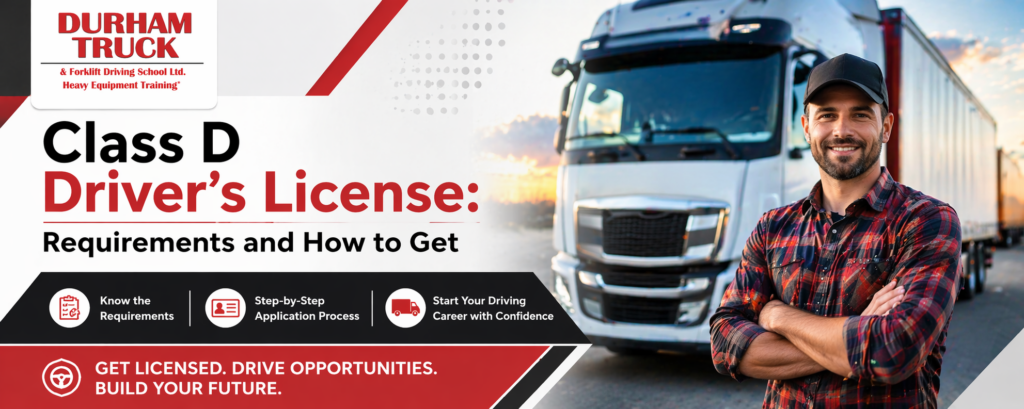
If you are looking to drive straight trucks, large vans, or certain commercial vehicles in Ontario, a Class D license is the credential you need. It is one of the most practical and accessible commercial driving licenses available in the province — and for many people, it is the first step toward a long and rewarding career in the transportation industry.
What Is a Class D Driver’s License?
A Class D license in Ontario authorizes you to operate straight trucks — that is, single-unit commercial vehicles where the cargo area and cab are built on the same chassis. Think large delivery trucks, moving vans, cube trucks, and dump trucks. Unlike a tractor-trailer (which requires an AZ license), straight trucks are a single connected unit.
The “D” classification sits within Ontario’s tiered licensing system, which ranges from Class G (standard passenger vehicles) all the way up to Class A (tractor-trailers). Class D falls in the middle, covering vehicles that are heavier and more complex than a standard car but don’t involve towing a separate trailer unit.
If the vehicle also has air brakes, you’ll need a “Z” endorsement added to your Class D — but more on that shortly.
What Vehicles Can You Drive With a Class D License?
With a valid Ontario Class D license, you can legally operate:
- Straight trucks over 11,000 kg GVWR (Gross Vehicle Weight Rating)
- Cube vans and box trucks used for commercial deliveries
- Dump trucks and flatbed straight trucks
- Moving trucks (both commercial and rental fleets)
- Any straight truck without air brakes (air brakes require the Z endorsement)
You cannot use a Class D license to operate a vehicle towing a trailer that exceeds 4,600 kg, nor can you drive a tractor-trailer combination — that requires a Class AZ license. If your career goals eventually include tractor-trailer driving, you may want to explore the AZ Driver Program at Durham Truck Training as your next step.
Class D License Requirements in Ontario
Before enrolling in a training program or visiting a DriveTest centre, confirm you meet these Ministry of Transportation requirements:
Age: You must be at least 18 years old.
Valid Ontario G License: You need a full Class G license — not a G1 or G2. This confirms you already have a foundation of safe driving habits and road awareness.
Medical Examination: You must pass a commercial driver medical exam. This assesses your vision, hearing, cardiovascular health, and overall physical fitness to operate a large vehicle safely.
Clean Driving Record: A serious driving history — multiple convictions, suspensions, or demerit points — can complicate your application. A reasonably clean abstract is strongly recommended.
English Proficiency: A minimum Grade 10 English reading level is required to complete the knowledge test and coursework.
Step-by-Step: How to Get Your Class D License in Ontario
Step 1: Pass the Class D Knowledge Test
Your first official step is visiting a ServiceOntario location and passing the Class D written knowledge test. This exam tests your understanding of:
- Ontario’s Highway Traffic Act as it applies to commercial vehicles
- Safe driving practices for large straight trucks
- Traffic signs, signals, and right-of-way rules
- Pre-trip inspection basics
- Load securement principles
Step 2: Enroll in a Class D Training Program
With your learner’s permit in hand, the next step is enrolling in a certified training program. Choosing a school registered under the Ontario Career Colleges Act, 2005 ensures your training meets provincial standards and is recognized by employers across Canada.
Durham Truck & Forklift Driving School Ltd. offers a structured Class D Program that combines classroom instruction with real behind-the-wheel training. The curriculum covers traffic laws and regulations, vehicle operation, defensive driving techniques, traffic control, and emergency situation management — everything you need to operate a straight truck with confidence and safety.
Step 3: Get Your Air Brake (Z) Endorsement if Required
Many straight trucks on today’s roads are equipped with air brake systems. If you plan to drive any vehicle with air brakes — which most professional straight truck positions will require — you need the “Z” endorsement added to your Class D license.
Air Brake “Z” Endorsement Course that teaches you how air brake systems function, how to test them before driving, and how to respond to brake-related issues on the road. Adding this endorsement significantly expands the range of vehicles you’re qualified to drive and increases your marketability to employers.
Step 4: Complete Your Behind-the-Wheel Training Hours
Hands-on driving practice is the most important part of Class D training. You’ll work with experienced instructors to develop skill in:
- Starting, stopping, and maneuvering a large straight truck
- Navigating intersections, roundabouts, and highway on/off ramps
- Reversing and backing into loading docks
- Managing blind spots and mirror usage
- Handling the vehicle in various weather and traffic conditions
The more hours you put in behind the wheel during training, the more confident you’ll be on test day — and in your first job.
Step 5: Book and Pass the Class D Road Test
Once your training is complete, you’ll book your Class D road test at a DriveTest centre. The examiner will evaluate your ability to perform a pre-trip inspection and safely operate the vehicle in real traffic conditions.
The test includes:
- A pre-trip vehicle inspection
- City and highway driving
- Reversing and backing maneuvers
- Proper mirror use and blind spot checks
- Following all traffic laws throughout
Students who complete structured training through a certified school consistently outperform self-taught applicants on road test day.
Financing Your Class D Training
Cost is a common concern for people considering commercial truck training. The good news is that multiple funding options exist to make your Class D program more affordable.
Durham Truck Training offers:
- EI Funding: If you are currently receiving Employment Insurance benefits, you may qualify for government-funded training support. Durham is approved to accept EI-assisted students.
- In-House Financing: Flexible payment plans are available directly through the school for students who need help spreading out the cost.
- Third-Party Financing: Durham works with financing partners to help students access funds quickly and get started without delay.
What Can You Do With a Class D License?
Once licensed, a wide range of job opportunities opens up across Ontario and beyond:
- Local and regional delivery driver (furniture, appliances, food service)
- Moving company driver (residential and commercial relocations)
- Construction and materials transport (dump trucks, flatbeds)
- Municipal services (waste collection, utility vehicles)
- Courier and logistics companies (large parcel and freight delivery)
The demand for Class D licensed drivers across Ontario remains consistently strong. Employers in construction, retail distribution, food and beverage, and municipal services are always looking for qualified drivers — and having your Class D puts you at the front of that line.
Ready to Take the Next Step?
Getting your Class D license is one of the most practical investments you can make in your career. The path is straightforward, the training is accessible, and the job market rewards qualified drivers generously.
Contact us today to learn more about the Class D Program, enrollment dates, and financing. With flexible training hours, experienced instructors, and a proven track record across Durham Region and the GTA, Durham is the trusted choice for first-time commercial drivers in Ontario.
Frequently Asked Questions (FAQs)
1. What is the difference between a Class D and Class AZ license?
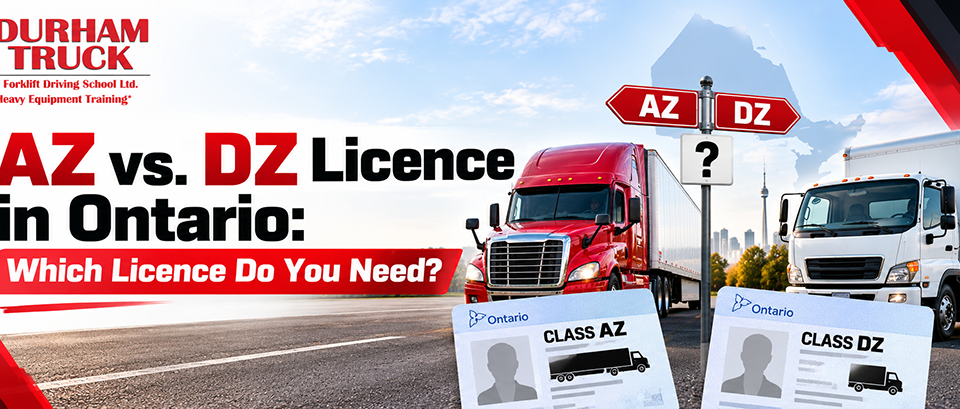
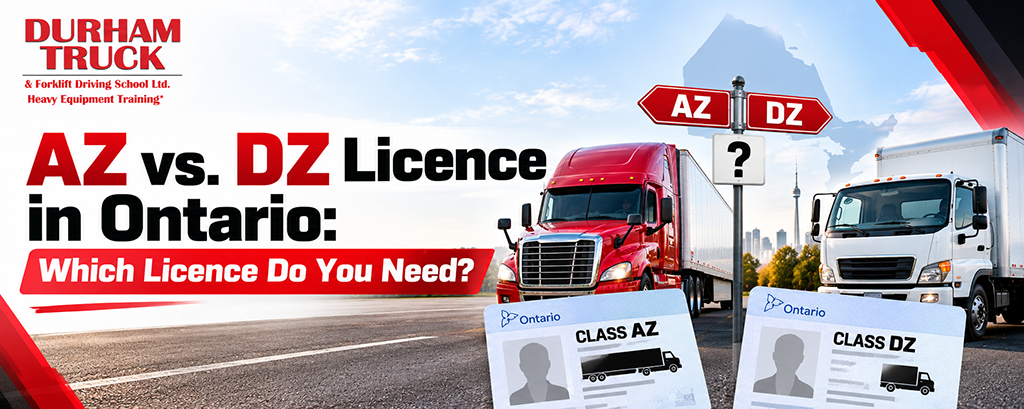
A Class D license allows you to operate straight trucks, while a Class AZ license permits you to drive tractor-trailers (combination vehicles). Class AZ is more advanced, but Class D is often a great starting point in the commercial driving industry.
2. Do I need MELT training for a Class D license?
No. Mandatory Entry-Level Training (MELT) is only required for Class A (AZ) licenses. However, professional training is still highly recommended to improve your skills and job readiness.
3. How long does it take to get a Class D license in Ontario?
Most students complete the process in 2 to 6 weeks, depending on training availability, practice time, and how quickly they can book a road test.
4. How much does a Class D license cost?
Training programs typically cost between $2,000 and $5,000 CAD, depending on the school and course structure. Financing and funding options, including Employment Insurance (EI), may be available.
5. Can I drive a truck with air brakes using a Class D license?
Only if you have the Z endorsement. Without it, you are restricted to vehicles that do not use air brake systems.
6. Is the Class D knowledge test difficult?
The test is manageable with proper preparation. Studying the commercial driving handbook from the Ontario Ministry of Transportation will help you understand the rules, signs, and safety requirements needed to pass.
Durham Truck & Forklift Driving School Ltd is registered under the Ontario Career Colleges Act, 2005. We are one of the Durham region’s most experienced and respected transport driver training schools.